Kurt J Lesker Company GmbH

Fritz-Schreiter-Strasse 18
Dresden,  Germany  01259

Germany
http://www.lesker.com
  • Booth: B1316


Enabling Technology for a Better World

The Kurt J. Lesker Company is a leader in the design and manufacturing of vacuum technology solutions for your research and production applications. From the simplest components and fittings to intricate vacuum chambers and precision computer-controlled deposition systems, our company works with you to devise sound, economical solutions for all of your vacuum science needs. Our European Distribution Centre is in Dresden, Germany from where we serve our customers throughout Europe. We also have offices and warehouses across the globe. Visit our website for more information: www.lesker.com Enabling Technology for a Better World


 Press Releases

  • AI isn’t just accelerating materials discovery… it’s redefining how we run the lab.

    b3628e7b80c3ffd3517f2a2c5c7591e2-huge-screenshot-2026-06-15-081405.png

    With platforms like Kurt J. Lesker eKLipse AI-Ready Systems, we’re moving toward fully autonomous ALD workflows - where deposition, metrology, and AI-driven decision making operate in a continuous closed loop. 

    ➡️ Real-time data
    ➡️ AI-initiated recipes
    ➡️ Adaptive process control
    ➡️ Continuous optimization

    No manual iteration. Just faster learning cycles and higher-quality films.

    And the research is already catching up.

    Recent work on physics-informed Bayesian active learning for ALD pulse tuning shows how AI can autonomously identify optimal process conditions, converging in just a few iterations while reducing precursor usage and improving accuracy. 

    That’s the vision of autonomous research: 

    👉 AI designs the experiment
    👉 Tools execute it
    👉 Data feeds back instantly
    👉 The next experiment runs automatically

    The labs that adopt this model won’t just be faster - they’ll explore more of the materials space, with fewer resources, and better outcomes.

    We’re not talking about future potential anymore.
    It’s already happening.

    Interested in bringing AI-driven ALD into your lab? Message me to explore how we can enable autonomous workflows on your next system.

  • Behind every successful research facility is more than just advanced science, it's a foundation built on intentional space planning, reliable tools, and trust in the systems that support them.

    A recent research feature, Building Space, Tools, and Trust, highlights how long term investment in cleanroom infrastructure and tool ecosystems enables institutions to grow their research capabilities while maintaining consistency, access, and reliability.

    As cleanroom environments expand, the challenge isn't simply adding square footage, it's ensuring that new spaces integrate seamlessly with existing workflows, equipment, and user communities. This requires tools that are not only technically capable, but also designed for shared use, long term serviceability, and evolving research needs.

    Tools as the Backbone of Research Environments

    In advanced fabrication spaces, tools define what research is possible. From deposition and etching to handling and access systems, every piece of equipment must perform reliably under continuous use by a diverse group of users. Poorly integrated tools slow progress, and well designed tools enable it.

    Over the years, Gary Spinner has become widely respected not only for his technical expertise, but for the thoughtful, people-centered approach he brings to building and sustaining shared research environments. Known for balancing long-term infrastructure planning with day-to-day researcher needs, Gary has played a pivotal role in shaping fabrication spaces that prioritize reliability, accessibility, and collaboration. His leadership extends beyond equipment decisions, fostering strong professional relationships rooted in trust, mutual respect, and a shared commitment to advancing the vacuum and research communities.
    building-space-tools-trust-the-infrastructure-that-enables-research-to-scale-01.jpg

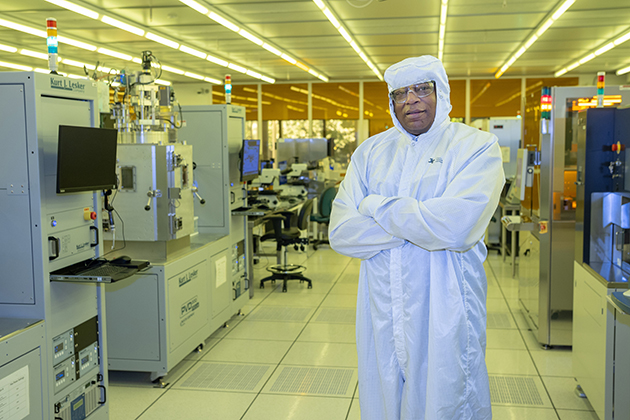
    Spinner in the Marcus Nanotechnology Cleanroom, standing in front of Kurt J. Lesker Company systems, shortly after the newest expansion opened in Fall 2025.

    Partnerships like this are often best understood through the people who help shape them. In reflecting on the themes highlighted in the Building Space, Tools, and Trust article, Joe Becker, Regional Account Manager at the Kurt J. Lesker Company, offers a personal perspective on the long-standing collaboration between Georgia Tech and KJLC.

    "My relationship with Gary Spinner began more than 20 years ago, and his connection with the Kurt J. Lesker Company spans just as long, paralleling his more than three decades at Georgia Tech. Throughout that time, Gary has been a driving force behind the development of Georgia Tech's cleanroom and fabrication environments, built on a foundation of reliability, shared access, and sustainable growth. That philosophy closely aligns with KJLC's mission of Enabling Technology for a Better World.

    Gary was among the earliest adopters of our technology, purchasing one of our original PVD 75 tools in the early 2000s. Over the years, he has continued to expand those capabilities with the addition of an ALD150LX and two PVD200 sputter tools. These are investments that reflect a long-term approach to infrastructure planning and research enablement."

    Outside the cleanroom, those relationships often take on a personal dimension as well. Something as simple as a shared passion for the Pittsburgh Steelers has led to many memorable conversations over the years. It's this blend of technical vision, approachability, and genuine connection that makes Gary not just a valued partner, but someone colleagues are proud to call a friend.

    KJLC's approach to process equipment and vacuum solutions is grounded in this reality. By focusing on modularity, service access, and long term support, we help research facilities deploy tools that scale alongside their ambitions without sacrificing performance or uptime.

    Designing for Growth, Not Just Today

    One of the key takeaways from the research feature is that infrastructure decisions made early have lasting impact. Cleanroom layouts, tool placement, and access systems all influence how effectively a facility can grow over time. Flexible design and forward thinking equipment choices allow institutions to expand capabilities without constant disruption.

    This same mindset drives how KJLC partners with research organizations by supporting not just initial installation, but the full lifecycle of the facility from early growth through long term operation. Trust Built Through Reliability.

    Ultimately, trust is earned through consistency. Researchers rely on tools that work as expected, facilities that are accessible, and tools that support collaboration rather than restrict it. When infrastructure fades into the background, innovation can take center stage.

    The Building Space, Tools, and Trust article underscores how people and tools come together to create environments where research thrives. At KJLC, we're proud to play a role in enabling those environments by delivering the tools that help institutions build not just space, but confidence in what's possible.

  • Behind every successful research facility is more than just advanced science, it's a foundation built on intentional space planning, reliable tools, and trust in the systems that support them.

    A recent research feature, Building Space, Tools, and Trust, highlights how long term investment in cleanroom infrastructure and tool ecosystems enables institutions to grow their research capabilities while maintaining consistency, access, and reliability.

    As cleanroom environments expand, the challenge isn't simply adding square footage, it's ensuring that new spaces integrate seamlessly with existing workflows, equipment, and user communities. This requires tools that are not only technically capable, but also designed for shared use, long term serviceability, and evolving research needs.

    Tools as the Backbone of Research Environments

    In advanced fabrication spaces, tools define what research is possible. From deposition and etching to handling and access systems, every piece of equipment must perform reliably under continuous use by a diverse group of users. Poorly integrated tools slow progress, and well designed tools enable it.

    Over the years, Gary Spinner has become widely respected not only for his technical expertise, but for the thoughtful, people-centered approach he brings to building and sustaining shared research environments. Known for balancing long-term infrastructure planning with day-to-day researcher needs, Gary has played a pivotal role in shaping fabrication spaces that prioritize reliability, accessibility, and collaboration. His leadership extends beyond equipment decisions, fostering strong professional relationships rooted in trust, mutual respect, and a shared commitment to advancing the vacuum and research communities.

    building-space-tools-trust-the-infrastructure-that-enables-research-to-scale-01.jpg

    Spinner in the Marcus Nanotechnology Cleanroom, standing in front of Kurt J. Lesker Company systems, shortly after the newest expansion opened in Fall 2025.

    Partnerships like this are often best understood through the people who help shape them. In reflecting on the themes highlighted in the Building Space, Tools, and Trust article, Joe Becker, Regional Account Manager at the Kurt J. Lesker Company, offers a personal perspective on the long-standing collaboration between Georgia Tech and KJLC.

    "My relationship with Gary Spinner began more than 20 years ago, and his connection with the Kurt J. Lesker Company spans just as long, paralleling his more than three decades at Georgia Tech. Throughout that time, Gary has been a driving force behind the development of Georgia Tech's cleanroom and fabrication environments, built on a foundation of reliability, shared access, and sustainable growth. That philosophy closely aligns with KJLC's mission of Enabling Technology for a Better World.

    Gary was among the earliest adopters of our technology, purchasing one of our original PVD 75 tools in the early 2000s. Over the years, he has continued to expand those capabilities with the addition of an ALD150LX and two PVD200 sputter tools. These are investments that reflect a long-term approach to infrastructure planning and research enablement."

    Outside the cleanroom, those relationships often take on a personal dimension as well. Something as simple as a shared passion for the Pittsburgh Steelers has led to many memorable conversations over the years. It's this blend of technical vision, approachability, and genuine connection that makes Gary not just a valued partner, but someone colleagues are proud to call a friend.

    KJLC's approach to process equipment and vacuum solutions is grounded in this reality. By focusing on modularity, service access, and long term support, we help research facilities deploy tools that scale alongside their ambitions without sacrificing performance or uptime.

    Designing for Growth, Not Just Today

    One of the key takeaways from the research feature is that infrastructure decisions made early have lasting impact. Cleanroom layouts, tool placement, and access systems all influence how effectively a facility can grow over time. Flexible design and forward thinking equipment choices allow institutions to expand capabilities without constant disruption.

    This same mindset drives how KJLC partners with research organizations by supporting not just initial installation, but the full lifecycle of the facility from early growth through long term operation. Trust Built Through Reliability.

    Ultimately, trust is earned through consistency. Researchers rely on tools that work as expected, facilities that are accessible, and tools that support collaboration rather than restrict it. When infrastructure fades into the background, innovation can take center stage.

    The Building Space, Tools, and Trust article underscores how people and tools come together to create environments where research thrives. At KJLC, we're proud to play a role in enabling those environments by delivering the tools that help institutions build not just space, but confidence in what's possible.

Categories


Send Email

Type your information and click "Send Email" to send an email to this exhibitor. To return to the previous screen without saving, click "Reset".